
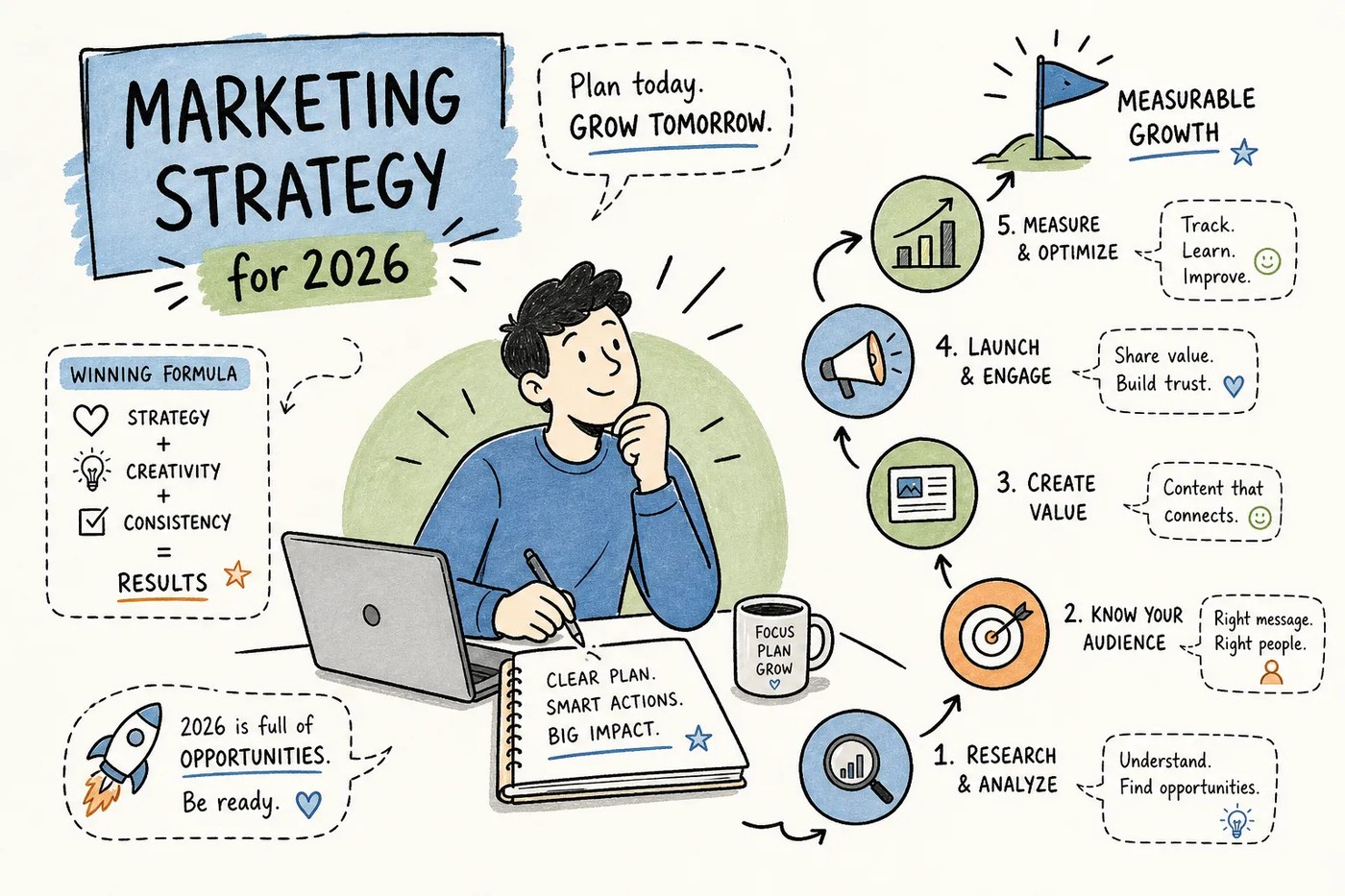
Most small businesses are not failing at marketing because they're not trying hard enough, they're failing because they don't have a clear digital marketing strategy. Ads launch without a defined audience. Social content goes out without a purpose. Success gets measured in likes instead of leads or revenue. The result is a marketing budget that disappears with nothing concrete to show for it.
At The Matador Group, we work with small business owners in Houston who arrive with exactly this problem: a handful of disconnected tactics, no cohesive roadmap, and no clear way to tell what's working. The framework we use to fix that is a seven-step process covering goals, audience research, channel selection, content planning, budget allocation, and measurement. This article walks through each step. It's the same process we apply to real campaigns for real businesses, not a textbook exercise.
Why your marketing keeps producing random results
Running Google Ads is a tactic. Knowing your target customer acquisition cost, which audience segment to reach, and what the ad needs to accomplish at each stage of the funnel is strategy. Without that strategic layer, you end up duplicating effort across channels, burning budget on audiences that won't convert, and having no way to explain why a campaign worked or didn't. Effort isn't the problem. Direction is.
Even with strong effort, that direction has to start with SMART goals: specific, measurable, achievable, relevant, and time-bound. "Get more website traffic" is not a goal. "Increase qualified leads by 30% in Q1 by improving paid search conversion rate" is a goal. Every objective should connect back to a business outcome, whether that's revenue, customer acquisition cost, or lifetime value. Vanity metrics are easy to chase and useless to report on when someone asks whether marketing is paying off.
Know your audience before you touch a channel
Channel selection should not happen by instinct or platform popularity. It should follow audience behavior. Before you decide where to advertise, you need a clear picture of who you're reaching and what they're trying to accomplish. A practical buyer persona covers the core fields that actually affect marketing decisions: the primary problem, the desired outcome, the buying trigger, the main objection, preferred information sources, and the decision criteria.
This is research work, not a creative exercise. Pull from your CRM, customer interviews, search behavior data, and past campaign results to validate your assumptions. Then map the buyer's journey from awareness through consideration to decision. At each stage, your customer is asking different questions, trusting different content types, and responding to different calls to action. That journey map becomes the backbone of your entire content plan. Build it early and the rest of the strategy becomes significantly easier to execute.
Choosing the right channels for your digital marketing strategy in 2026
The strongest channel mix in 2026 depends on your business model, not on what's trending on marketing Twitter. B2B businesses get the most traction from SEO, paid search, email nurture sequences, and LinkedIn. B2C businesses win through paid social, short-form video, creator partnerships, and social commerce. Across industry benchmarks and our own campaign data, paid social consistently delivers the strongest ROI for B2C businesses. Email holds that position for B2B because it supports long sales cycles and multiple stakeholders.
Use the owned, earned, and paid framework to organize your channel decisions within your broader multichannel marketing plan. Owned media includes your website, email list, and blog. Earned media covers organic search visibility, reviews, and referrals. Paid media is everything you buy: search ads, social ads, and sponsored content. Before committing new budget anywhere, audit what you already have. A neglected email list or an underoptimized Google Business Profile can produce results faster than a new ad channel you haven't tested yet.
The practical rule for most small businesses: start with one or two channels and do them well. Focus on one intent-capture channel like paid search, one relationship channel like email or LinkedIn, and one conversion channel like a landing page with a clear offer. When businesses spread thin across every platform at once, budgets tend to disappear without meaningful results to show for it.
Building a content plan for your digital marketing strategy
Every piece of content should have a defined role in the buying process, a clear call to action, and a success metric. The TOFU, MOFU, BOFU structure makes this straightforward. Top-of-funnel content, like educational guides and short videos, serves awareness. Middle-of-funnel content, like case studies and comparisons, serves consideration. Bottom-of-funnel content, like demos, pricing pages, and testimonials, serves the decision stage. If a piece of content doesn't fit one of those three categories, you need to rethink why you're creating it.
A lean editorial calendar is the tool that makes this system repeatable. For each piece of content, define the audience segment, topic, funnel stage, format, channel, call to action, owner, and publish date. That structure prevents the common problem of creating content on gut instinct with no connection to what the customer actually needs at that moment. Start with one strong pillar asset per month and repurpose it into email copy, social posts, and paid creative. Consistency beats volume every time. Research consistently shows that fewer, stronger pillar assets repurposed across channels outperform a high volume of low-quality content produced at the same pace.
Budget allocation and KPIs that actually mean something
For most small businesses building out their first real online marketing strategy, a practical starting allocation looks like this: paid search at 25%, content marketing at 20%, SEO at 20%, paid social at 15%, email at 10%, and the remaining 10% reserved for testing, analytics, and tools. That split gives you roughly 40% in paid acquisition and 50% in owned and organic channels. It's not permanent, it's a starting hypothesis you refine as data comes in.
Adjusting your allocation by goal
- Urgent lead generation: Increase paid search to 30%, bump paid social to 20%, and pull back on content and SEO until paid channels prove out.
- Long-term organic growth: Shift to 25% SEO, 25% content, and reduce paid spend to 15% until organic builds momentum.
- B2B or high-consideration services: Weight toward content at 25%, email at 15%, SEO at 20%, and keep paid social lean at 10%.
Building a KPI tree
On the measurement side, build a KPI tree rather than tracking disconnected metrics. Start with the business objective, identify the marketing outcome that supports it, pick the primary KPI, then track the channel-level metrics that drive it. For e-commerce, that means tracking CAC, ROAS, and repeat purchase rate. For B2B, focus on cost per qualified lead, MQL-to-SQL rate, and pipeline ROI. The LTV to CAC benchmark to work toward is 3:1 as a minimum operating floor, a ratio closer to 4:1 gives you more sustainable room to grow.
The execution gap: where most digital marketing strategies stop working
Even with the right KPIs in place, execution is where most strategies fall apart. The strategy document is rarely the problem. What happens after it's written is. The most common failure points are vague ownership, inconsistent tracking, disconnected tools, content bottlenecks, and optimization cycles that are too slow to catch problems before they compound. A plan with no named owner, no 90-day roadmap, and no measurement infrastructure in place before launch will not produce results, no matter how solid the planning looks on paper.
The minimum viable execution model that actually works includes three to five priorities tied directly to business outcomes, a 90-day roadmap with deliverables and deadlines, and tracking and analytics instrumented before the first campaign goes live. Pair that with a fixed review cadence:
- Weekly: Operational metrics like CTR and conversion rate
- Monthly: CAC and ROAS
- Quarterly: LTV, payback period, and channel ROI
That rhythm is what separates businesses that improve over time from ones that keep rebooting the same underperforming campaigns.
Most small business owners don't have the bandwidth to manage paid search, Meta Ads, content production, and analytics at the same time. That's not a personal failure, it's the reality of running a business without a dedicated marketing team. This is where The Matador Group comes in. The team handles the full execution layer, Google Ads management, Meta Ads management, inbound marketing plan development, and Google Tag Manager setup, so small businesses can move forward with a working, measurable digital marketing roadmap without spending months figuring out the details on their own.
Put the framework to work
The seven steps, taken in order, give you everything you need to build a real digital marketing strategy: goals tied to business outcomes, a research-backed audience profile, channel selection based on buyer behavior, content mapped to funnel stages, a budget you can defend, KPIs connected to revenue, and an execution model built for consistency. None of it is complicated in isolation. The challenge is running it all at once without letting any layer fall apart.
A digital marketing strategy is only as good as its execution. Writing it is the easy part. Running it consistently, measuring it correctly, and optimizing it month after month is where most small businesses hit a wall. If designing and executing a full marketing plan isn't where your time should go, get in touch with The Matador Group. We work with small businesses to develop strategies that produce measurable results, not just activity. Reach out for a free digital marketing strategy audit and see how the approach applies to your business.
Want the numbers on your own account? Thirty minutes, free. We look at your accounts, your creative and your spend, and tell you the three things we’d change first - whether you hire us or not. And every client is covered by our No Bull Guarantee, including full access to your own ad accounts.
Book my free consultation