
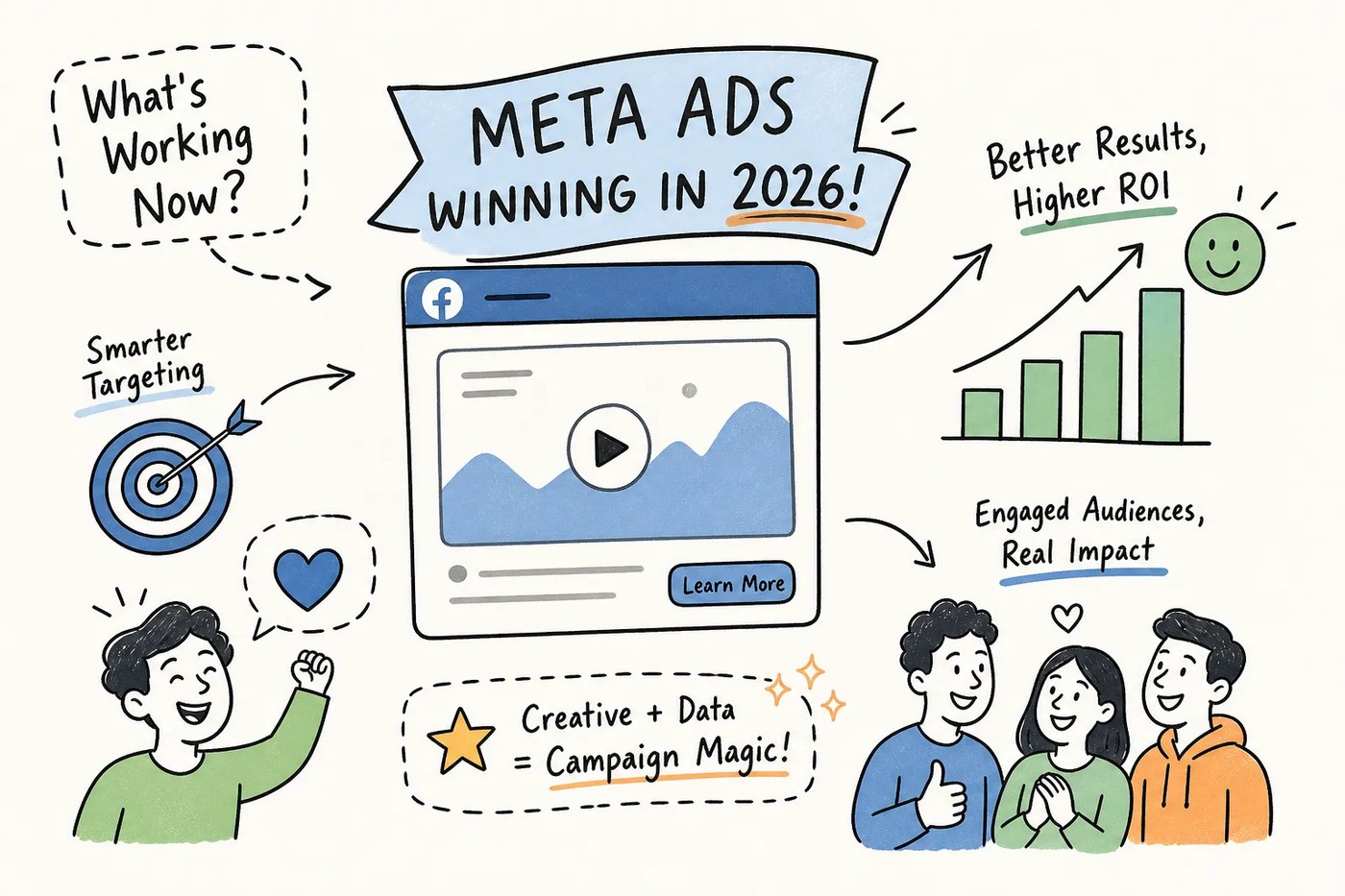
The best meta ads campaigns in 2026 are hitting 3.71% CTR, 5.8% CVR, and 3.5x ROAS. Everyone else is averaging 1.93% CTR. That gap isn’t solely a budget problem, structure and creative are the most common culprits, and both are fixable once you understand what the highest-performing Facebook ad campaigns are actually doing differently. (Budget, offer strength, tracking implementation, and campaign data volume also play a role, but structure and creative are where most accounts leave the most performance on the table.)
At The Matador Group, we track these patterns across client campaigns out of our Houston office, and the same formulas keep showing up across industries. This article breaks down the ad formats, creative structures, copy patterns, and campaign architecture behind what’s working right now, so you can build campaigns that compete at that top-tier level.
The ad formats outperforming everything else in 2026
Format choice isn’t aesthetic; it’s strategic. Mismatching your format to the wrong funnel stage is one of the most common budget leaks in Meta Ads Manager, and the 2026 benchmarks make the right choices clearer than ever.
Reels for cold-audience prospecting
Short vertical video, specifically Reels in the 6, 15 second range, consistently produces the highest engagement and lowest CPC against cold audiences this year. The format rewards native, fast-opening creative that looks organic rather than produced. Benchmarks from recent industry analysis show Reels generating 2, 4x higher CTR than static images in cold prospecting placements, with CPA running roughly 34.5% lower than image ads when the creative is vertical and sound-on.
The first three seconds carry all the weight. Your opening frame needs motion, your hook needs to land by second one, and the payoff needs to be visible by second three. If someone can’t understand what you’re promising with the sound off, you’ve already lost them.
Carousel ads and their edge in retargeting
Carousels continue to generate 30, 50% lower cost per conversion than single images in retargeting scenarios, according to Meta advertising benchmarks tracking funnel-stage performance. The reason is straightforward: warm audiences already know you exist, and multiple cards let them compare, explore, and self-select the offer or product most relevant to them. This format works especially hard for multi-product catalogs and offer-led retargeting creative where giving the audience choices increases the probability of a click.
Collection and Instant Experience for mobile purchase
For ecommerce, Collection ads paired with a catalog feed are producing some of the highest ROAS in 2026 benchmarks: 2.35x in sports and outdoors, 2.28x in travel accessories, and 3.20x in home services. The format reduces friction by keeping the browse experience inside Meta, which means fewer drop-offs between ad click and purchase intent. When your audience can shop without leaving the app, conversion rates climb.
The creative formulas showing up in every top campaign
High-performing Facebook ad creatives share a consistent internal logic regardless of industry or budget. It’s not production value driving results, it’s structure. These are repeatable formulas, not lucky accidents.
UGC video: Meta ad examples and the hook-problem-proof-CTA structure
UGC-style video is the dominant creative format in top Meta ad examples right now, and the structure is consistent: hook in seconds 1, 3, problem acknowledgment, quick product demonstration, a social proof element, then offer and CTA. Native-looking, low-production video outperforms polished brand content for cold audiences because it reduces the “this is an ad” friction that causes viewers to scroll past. When your creative looks like content rather than advertising, it earns the watch time it needs to convert.
Problem-first hooks and the before/after framework
Two hook categories dominate 2026’s top ad creatives. The first is problem-first: “Still dealing with X?” or “Stop doing X if you want Y.” The second is result-first, where you show the after before explaining the before. The before/after format works best when the transformation is specific and visually credible. “I lost 12 pounds in 6 weeks” converts better than “I transformed my body,” because specificity signals honesty. Exaggerated transformations trigger skepticism, not clicks.
Demo-led creative for products that need to be seen
For products whose value is immediately visible, home goods, tools, software interfaces, cleaning products, the demo format is consistently reliable. The structure: show the result in the first five seconds, demonstrate the mechanism, address one objection, close with CTA. Keep it to 15, 40 seconds. The goal is to let the product prove itself before the viewer’s attention runs out.
What the best Meta ad copy actually looks like
Most advertisers get creative directionally right and copy completely wrong. The specific patterns in primary text and headlines that recur across top-performing Meta ad examples in 2026 are worth knowing before you write another word of ad copy.
Headlines: short, benefit-led, and under 40 characters
The strongest recurring headline pattern in 2026 is benefit-specific and tight. “Get [outcome].” “Save [amount].” “The easier way to [result].” Specificity beats cleverness every time, and headlines that match the landing page action outperform vague teasers. If your headline says “Save 40% on your energy bill” and your landing page leads with the same message, you’re building trust through consistency. If they don’t match, you’re introducing friction at exactly the wrong moment.
Primary text: what lands before the “See More” cutoff
For cold Feed traffic, 60, 125 characters in the primary text is the most consistently recommended range. The first line carries the full weight of the hook, whether that’s an audience qualifier, a specific result, or a direct problem statement. Five copy formulas recur most often in high-performing campaigns:
- Problem-solution: “Still dealing with [pain]? [Product] helps you [specific outcome] without [common drawback].”
- Outcome plus timeframe: “Get [specific result] in [timeframe] without [objection].”
- UGC testimonial: “I tried [old solution] and got [problem]. After using [product], I [specific result].”
- Demo-first: “Watch [product] solve [problem] in seconds.”
- Offer-led: “Save [percentage/amount] on [product] through [date].”
Test problem-first against result-first before assuming one works better for your audience. The winning formula is almost always category- and audience-specific, not universal.
Best meta ads campaigns: full-funnel structures that hold up at scale
High-performing Meta campaigns in 2026 aren’t built around a single winning ad. They’re built around structured funnels with distinct objectives, creative, and bidding at each stage. The architecture is what makes campaigns scalable without collapsing ROAS.
TOF prospecting: broad targeting and Advantage+ audience
Top-of-funnel campaigns optimized for Purchase with broad targeting or Advantage+ Audience are outperforming tightly segmented interest-based setups this year. The reason is consolidation: fewer ad sets means more concentrated conversion data, faster learning, and better delivery optimization. Meta’s algorithm performs better when it has more signal to work with, and fragmented ad sets starve it of the data it needs. One consolidated prospecting campaign with strong creative outperforms five narrowly targeted campaigns with mediocre creative almost every time.
MOF and BOF retargeting with offer-led creative
Middle-of-funnel audiences, site visitors, video viewers, social engagers, respond to testimonials, objection-handling creative, and comparisons. They’ve seen you before; now they need a reason to trust you. Bottom-of-funnel audiences (add-to-cart users, checkout abandoners, CRM lists) need urgency, specific offers, and dynamic product ads. Audience exclusions matter here: recent purchasers should be excluded from both retargeting layers to avoid wasting spend and creating a poor post-purchase experience.
Bidding progression: from Lowest Cost to Minimum ROAS
Successful accounts follow a clear bidding ladder rather than jumping straight to ROAS optimization. Start with Lowest Cost to gather conversion signals without constraining delivery. Move to Cost Cap once you have a stable CPA baseline, setting it roughly 10, 20% above your trailing average rather than at an aggressive target. Reserve Minimum ROAS for mature ecommerce accounts with reliable purchase-value tracking and at least 50 purchases per ad set per week. Jumping to ROAS bidding too early starves the algorithm of data and usually produces underspend, not efficiency.
How the top accounts scale without destroying efficiency
Scaling is where most campaigns break. The accounts that scale successfully follow a disciplined process with hard guardrails, not arbitrary budget increases driven by impatience.
The budget increment rule and when to apply it
A common practice among scaling accounts is to increase budgets 20, 30% every 48, 72 hours, though conservative accounts often prefer 10, 20% increments over 3, 5 days depending on account maturity and volatility. Either way, three conditions need to be true before you touch the budget: the learning phase is complete, CPA is at or below target, and frequency isn’t showing saturation signals. Increasing budget while the campaign is still in learning resets the learning phase and wastes the data you’ve already accumulated. The rule isn’t about the exact percentage, it’s about the timing and the conditions.
Horizontal scaling through new creative angles, not new ad sets
The safer scaling path in 2026 is creative expansion: new hooks, new creators, new formats, new opening frames, all preserving the winning offer and angle. Duplicating ad sets into new interest audiences typically dilutes performance because you’re splitting signal across more structures without adding real reach. Expanding creative width builds on existing signal without resetting delivery or fragmenting your data. When vertical budget increases start showing CPA deterioration, expand horizontally through creative before expanding through audience.
What agencies like The Matador Group build for Houston small businesses
Not every small business has the time or in-house expertise to build, test, and iterate full-funnel Meta campaigns while running their actual business. The strategy covered in this article isn’t complicated once you know the structure, but executing it consistently requires dedicated focus.
Building high-converting campaigns on smaller budgets
The Matador Group specializes in Meta ads management for small businesses in Houston, building the same campaign structures outlined above but scoped to local budgets and specific business objectives. The principles don’t change at smaller scale: full-funnel architecture, tested creative formulas, and disciplined bidding still apply. What changes is prioritization, knowing which element to build first when resources are limited is a skill that only comes from running campaigns across dozens of accounts.
The team also uses AI-assisted tools to speed up analysis and surface patterns that would take longer to identify manually, which helps move faster on campaign decisions at the account sizes most small businesses operate at.
What to look for in a Meta ads partner
If you’re evaluating a Meta ads agency, three questions cut through the noise quickly. Do they test creative systematically, or do they run one ad and declare it a winner? Do they structure campaigns by funnel stage, or do they run everything as a single campaign? A third question is equally telling: do they follow a data-driven scaling process, or do they increase budgets based on gut feel? The answers tell you whether you’re hiring an agency that builds on strategy or one that runs on guesswork.
The takeaway: structure wins before creative does
The best meta ads campaigns of 2026 share a consistent logic, the right format at the right funnel stage, creative built around a repeatable formula, copy that hooks before the cutoff, and a campaign structure that consolidates data instead of fragmenting it. These are frameworks you run, test, and refine over time, not tactics you apply once and walk away from.
If your social media ad campaigns aren’t hitting the benchmarks covered in this article, the gap is almost always structural before it’s creative. Fix the architecture first, the funnel stages, the bidding progression, the format matching, then optimize the creative layer on top of a solid foundation. That’s the playbook behind the best meta ads campaigns pulling top-10% numbers this year.
If you’re a small business in the Houston area looking to implement these campaign structures with professional support, reach out to The Matador Group. We build Meta campaigns designed to scale, and we’ll audit what you’re currently running to show you exactly where the gaps are.
Want the numbers on your own account? Thirty minutes, free. We look at your accounts, your creative and your spend, and tell you the three things we’d change first - whether you hire us or not. And every client is covered by our No Bull Guarantee, including full access to your own ad accounts.
Book my free consultation