
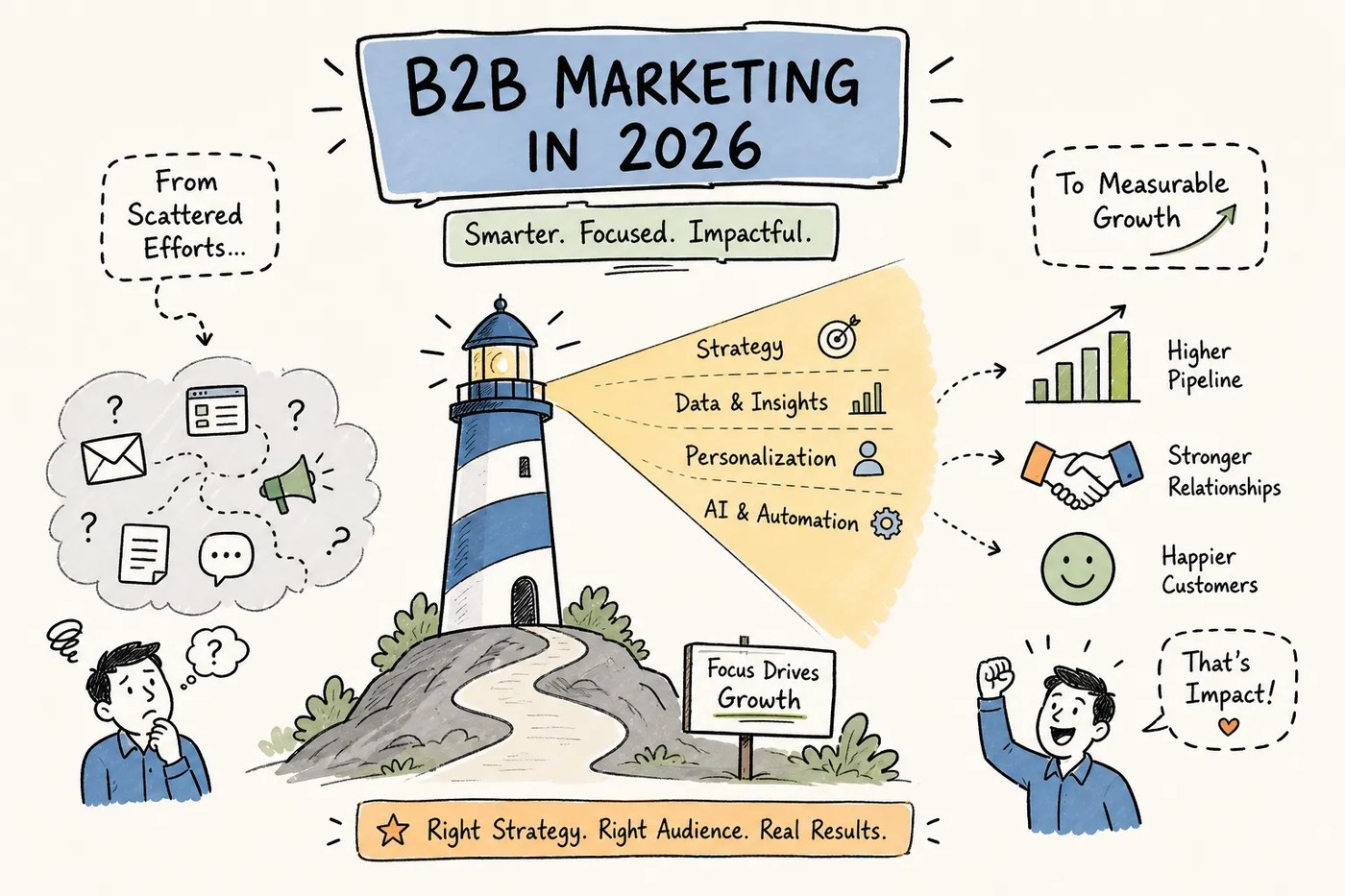
Many B2B teams fall into the same trap: posting on LinkedIn inconsistently, spending budget on disconnected ads, and calling the resulting chaos a strategy. The pipeline tells the truth. If your revenue isn't predictable month over month, your marketing isn't a system, it's a collection of activities dressed up as a plan.
After working with B2B businesses across Houston, the team at The Matador Group sees the same gaps repeatedly: no clearly defined ICP, no channel prioritization, and no way to trace what's actually generating opportunities versus what's generating noise. These aren't small problems. They're the reason well-funded marketing efforts stall without producing pipeline.
This article breaks down the frameworks, channels, and plan structure that B2B teams are actually using to grow in 2026. By the end, you'll have enough to draft a one-page B2B marketing strategy with real channel priorities, measurable KPIs, and a 90-day execution roadmap.
Why most B2B marketing plans never generate real pipeline
The most common mistake B2B marketing teams make is confusing output with outcomes. Publishing three blog posts a week, staying active on LinkedIn, and running paid search ads can all feel productive. Without a defined buyer journey and a specific ICP to anchor those efforts, though, you're spending money to generate traffic that doesn't convert. B2B SaaS website conversion rates benchmark around 1.1%, which means even meaningful traffic volumes produce almost nothing if the conversion infrastructure isn't built.
A real B2B marketing strategy is not a list of channels. It's a system that maps acquisition channels to a specific buyer, a specific stage in their decision process, and a specific conversion goal. Think of it as three connected layers: who you're targeting, how you reach them at each stage, and how you measure whether it's working. When those layers are disconnected, you end up with activity that looks like marketing but doesn't close deals.
Three proven frameworks every B2B marketer should build around
Account-based marketing: how to win high-value accounts on purpose
Account-based marketing flips the traditional demand-gen model. Instead of casting wide and hoping the right buyers show up, ABM aligns marketing and sales around a defined list of named accounts and builds personalized campaigns designed to move those specific accounts through the pipeline. The execution loop is straightforward: build your target account list, create content that speaks to each account's specific context, run account-level retargeting, and coordinate with sales on outreach timing so neither team is working in isolation.
ABM converts to opportunity at roughly 19.8% in benchmark data, and when concentrated spend targets accounts that are genuinely in-market, the revenue impact shows clearly. One hospitality SaaS company running account-level retargeting generated $262,604 in closed-won revenue and more than 14x return on ad spend. That's not what happens with broad-audience campaigns; it's what happens when marketing spend is concentrated on accounts with real intent signals behind them.
Content funnels that convert strangers into qualified buyers
Most B2B content programs fail because they only produce top-of-funnel awareness content. Blog posts about industry trends, social commentary, and general how-to guides attract readers but rarely move them toward a buying conversation. A functional content funnel covers all three stages: awareness content that captures early-stage research, consideration content that positions your approach against alternatives, and decision content like case studies and comparison guides that accelerates the final evaluation.
ContentDrive shifted from measuring pageviews to measuring content-sourced pipeline. Monthly MQLs grew from 50 to 210, a 4.2x increase, while customer acquisition cost came in 30% lower than paid advertising. That result doesn't come from publishing more. It comes from publishing content that answers buyer questions at the right stage and routing those buyers toward a conversion point that matches their intent.
LinkedIn outreach as a high-ROI channel for authority and ABM
LinkedIn is a highly effective channel for organic authority building and targeted ABM, while organic search and owned email typically deliver stronger lead-to-opportunity ROI (more on that below). Most teams undercut LinkedIn's potential by treating it as a broad paid acquisition vehicle. The real leverage is combining consistent posting from genuine subject-matter experts with targeted promotion to specific named accounts, the credibility built organically makes paid amplification and direct outreach sequences far more effective.
Goldcast ran an $8,000 LinkedIn campaign using authentic posts from real product users, then promoted those posts to target accounts. The result: $700,000 in pipeline and $400,000 in closed-won revenue. The lesson isn't to copy the tactic exactly. It's that LinkedIn works best when content is credible and targeting is account-specific, not when you're throwing budget at broad awareness campaigns and hoping decision-makers notice.
Which channels deliver the best lead-to-opportunity ROI in your B2B marketing strategy
When you compare B2B channels by cost per opportunity rather than cost per click or cost per lead, the rankings shift considerably. According to industry benchmark data, organic search produces approximately $860 per opportunity and house email comes in around $866, making both strong anchors for any B2B digital marketing program. ABM, despite higher cost per lead, converts at 19.8% and lands around $2,460 per opportunity. Paid search runs approximately $4,250 per opportunity, and broad paid social sits at roughly $4,341 with only 4.1% lead-to-opportunity conversion. (Note: these figures reflect benchmark averages; your numbers will vary based on attribution model, deal size, and database quality.)
Use this as a decision tool rather than a definitive ranking. Deal size, sales cycle length, and database quality all shift the math. Channel selection should also shift based on company stage. Organic search builds compounding pipeline over time; paid search gets you in front of high-intent buyers faster but at a steeper cost.
- Under $1M ARR: Focus on one content channel, email, and LinkedIn organic. Keep CAC experiments cheap and monitor results over 90-day cycles.
- $1M to $10M ARR: Introduce ABM and paid LinkedIn for named account targeting, and add marketing automation to manage nurture sequences at scale.
- Enterprise: Coordinated paid ABM, field marketing, and multi-stage content programs become necessary to manage buying committees and 18- to 24-month sales cycles.
How to build your one-page B2B marketing strategy
Step 1: Define your ICP and map the buyer journey
Your ICP needs to be specific across three dimensions:
- Firmographic: What industry, company size, and ARR range are you targeting?
- Behavioral: What trigger events signal buying intent, and what actions do in-market buyers take before reaching out?
- Stakeholder: Who owns the budget, who feels the pain, and who needs to approve the deal?
Most B2B teams define their ICP at the firmographic level and stop there, which is why their messaging hits the right companies but the wrong people inside those companies. Once you have the ICP, map three to four buyer journey stages from first-touch awareness to closed deal. Assign one channel and one content asset to each stage. This connects marketing activity to actual buyer behavior rather than treating all content and all channels as interchangeable.
Step 2: Pick your priority channels and define three revenue-tied KPIs
Three channels executed well consistently outperform six channels executed poorly. Spreading effort too thin produces mediocre results everywhere and makes it nearly impossible to know what's actually working. Pick the channels that match your ICP, your budget stage, and your sales cycle, then commit to them for at least one full quarter before drawing conclusions.
For KPIs, tie each one directly to revenue. Marketing-sourced pipeline shows whether your channels are creating real opportunities. Cost per opportunity reveals whether those channels are efficient. MQL-to-SQL conversion rate is your signal that lead quality is strong enough for sales to act on. Healthy LTV:CAC ratios run 3:1 at the startup stage and 4:1 to 6:1 at scale, your channel KPIs should connect back to that math.
Step 3: Choose tactical projects with timelines
A 90-day planning structure keeps execution grounded. One content asset, such as a case study or comparison guide, builds organic credibility and supports late-stage buyers. One outbound sequence, either LinkedIn or email, puts your message directly in front of ICP-fit decision-makers. One paid experiment, such as ABM retargeting or a focused paid search campaign, tests a scalable channel. One conversion optimization project, whether that's a landing page rewrite or a better demo CTA, improves the yield on traffic you're already generating.
Each project should be tied to a specific KPI before execution starts, so "what does success look like?" has a concrete answer on day one rather than becoming a debate on day 90.
The team, tools, and AI edge that make this executable
Under $5M ARR, keep the team generalist-heavy: a marketing lead, a demand-gen generalist, and contractors for design, SEO, and paid media. Avoid premature specialization. At $5M to $50M ARR, add dedicated product marketing and marketing operations once campaign complexity makes generalist ownership unreliable, targeting six to 20 FTE. At $50M and above, build functional leaders across demand, content and brand, product marketing, and operations, with dedicated ABM and customer marketing roles.
For the tech stack, most B2B teams run HubSpot for CRM and marketing automation, Google Analytics 4 for behavioral data, and a dedicated attribution tool like Dreamdata or Factors.ai for multi-touch revenue reporting. Enterprise ABM programs add 6sense or Demandbase for intent signals and account identification. The biggest gap in most B2B stacks isn't automation capability, it's attribution. If you can't trace marketing spend back to closed revenue, channel decisions are essentially guesswork.
AI is compressing execution timelines in ways that change the competitive landscape. Snowflake tested AI-generated ad variants against human-written copy and saw 54% higher click-through rates from the AI versions. Beyond ad creative, AI tools are accelerating content personalization at scale and improving predictive lead scoring so sales teams focus on the right accounts at the right time. The competitive advantage in 2026 isn't budget size, it's the speed of the feedback loop between strategy, execution, and data.
The Matador Group works directly with B2B businesses in Houston to build and run these strategies, covering marketing strategy, ad management, and analytics infrastructure to close the gap between planning and pipeline.
B2B marketing strategy: build the plan this week, not next quarter
A B2B marketing strategy isn't a channel checklist. It's a connected system that runs from ICP definition through pipeline measurement, and every piece needs to connect to the next. When the ICP is vague, channel selection becomes guesswork. When channel selection is scattered, KPIs lose meaning. When KPIs aren't tied to revenue, the whole system drifts toward activity rather than outcomes.
The one-page plan structure is direct: define your ICP across firmographic, behavioral, and stakeholder dimensions. Pick the channels that match your stage and buyer. Set three KPIs tied directly to pipeline and revenue efficiency. Commit to four tactical projects for the next 90 days, each with a clear success metric going in. That's the whole framework, and it fits on a single page for a reason.
Execution is where most plans break down, and that's exactly where The Matador Group focuses its work with B2B businesses in Houston. If you want to move from framework to results, reach out to our team and start with the one-page plan this week.
Want the numbers on your own account? Thirty minutes, free. We look at your accounts, your creative and your spend, and tell you the three things we’d change first - whether you hire us or not. And every client is covered by our No Bull Guarantee, including full access to your own ad accounts.
Book my free consultation