
Many small business owners aren’t entirely sure what they’re paying for when they hire someone to manage their Google Ads. That’s not entirely an accident. Agency pricing has evolved in ways that can make Google Ads manager pricing feel opaque, and many proposals are structured to close deals rather than educate buyers.
At The Matador Group, we manage Google Ads for small businesses across Houston and beyond. In nearly every early conversation with a new prospect, some version of the same question comes up: “What does this actually cost, and how do I know it’s working?” It’s a fair question, and many people asking it have already been burned once.
By the end of this article, you’ll know exactly how AdWords manager pricing is structured in 2026, what hidden costs to watch for before you sign anything, and how to run the ROI math yourself so no agency can obscure the real numbers.
The three pricing models AdWords managers actually use
Percentage of ad spend
The most common Google Ads manager pricing model charges a percentage of whatever you spend monthly, typically between 10% and 20%. At $2,000 in monthly ad spend with a 15% management fee, that’s $300 on top of your budget. The math feels simple, but the conflict of interest is real: agencies using this model earn more when you spend more, which creates pressure to scale budgets even when scaling isn’t justified by results.
If you’re on this model, ask your agency to show you the threshold where increasing spend actually improved cost-per-conversion. If they can’t answer that clearly, the upsell pressure probably isn’t working in your interest.
Flat monthly retainer
A flat retainer charges a fixed fee regardless of your ad budget. This is the cleaner model for the client. You know exactly what you’re paying every month, and the agency has no financial incentive to inflate your budget to inflate their own fee. Flat retainers for small-business Google Ads management typically range from $500 to $3,500 per month in 2026, depending on account complexity, campaign volume, and what’s actually included in the scope.
Performance-based pricing
Performance-based pricing ties the agency’s fee to specific outcomes: leads generated, conversions completed, or a ROAS target. It sounds appealing on paper. The complications show up in practice. Attribution disputes are common, agencies control the reporting, and baselines are often set in ways that benefit the agency rather than the client. This model makes sense when both parties have a clear, measurable goal and a shared definition of attribution. For most small businesses with mixed traffic sources, it creates more friction than clarity.
What each AdWords management pricing tier actually includes
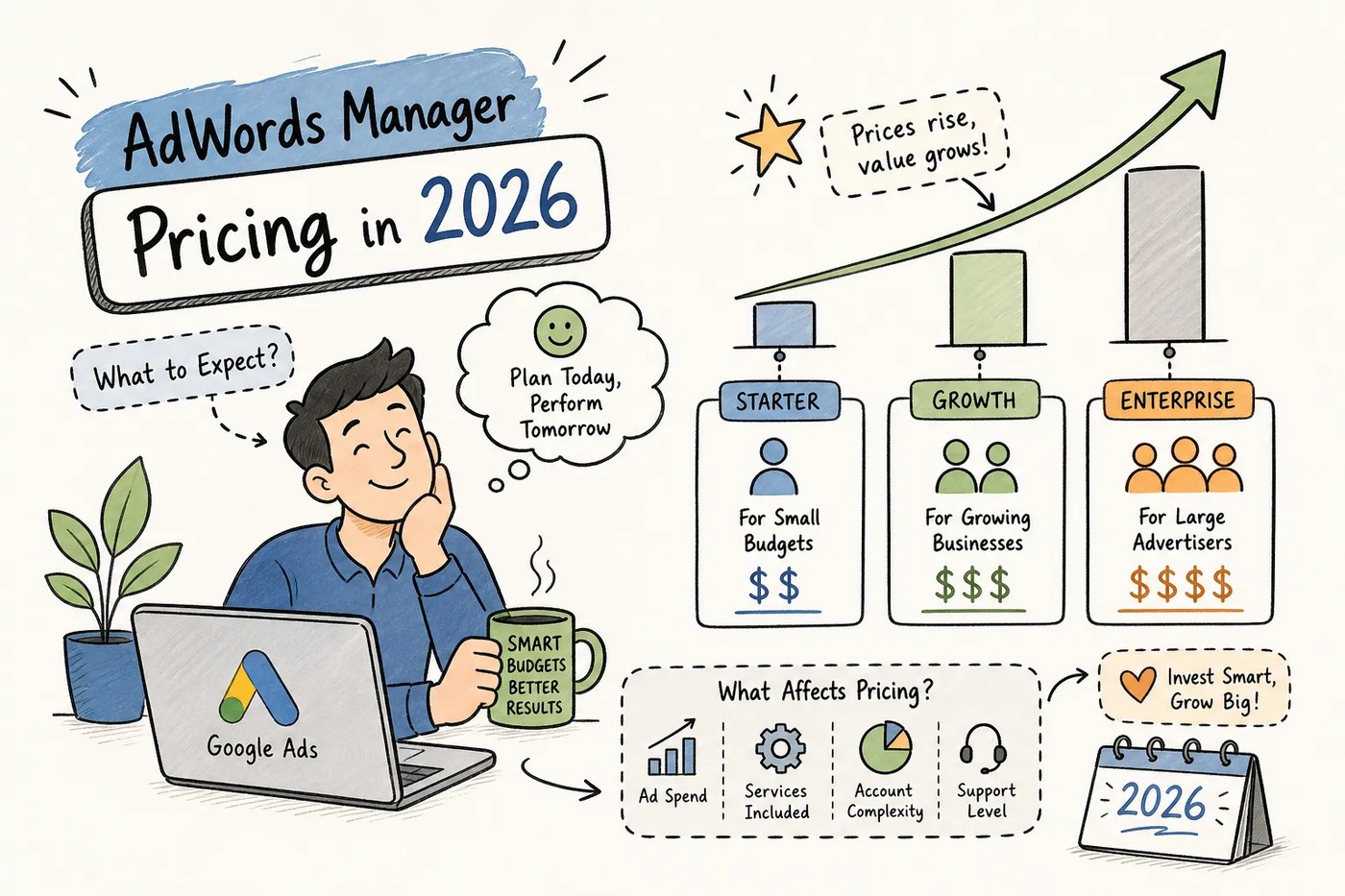
Entry-level plans ($500, $1,000/month)
At the entry level, expect basic campaign setup, keyword research, standard ad copy, and a monthly performance report. You’ll typically get one campaign type, usually Search, and up to three active campaigns. Advanced features like audience segmentation, A/B testing, and robust conversion tracking are generally reserved for higher tiers, and proactive between-report optimization is limited at this level.
This tier works for businesses brand new to paid search that just need a functional starting point. It’s not the right fit for anyone trying to compete in a moderately competitive market. You’ll hit the ceiling of what this level of management can deliver faster than you expect.
Mid-tier management ($1,000, $3,000/month)
This is where real traction becomes possible for most growing small businesses. Mid-tier management typically includes multiple campaigns, Search plus at least one additional campaign type, negative keyword maintenance, bi-weekly check-ins, A/B ad testing, conversion tracking, and audience layering. You’re not just running ads at this level; you’re building a structure that can be optimized over time.
When evaluating mid-tier packages, ask specifically about conversion tracking setup, how often the agency tests new ad variations, and whether audience exclusions are actively being used. These details separate agencies that are managing your account from those running it on autopilot.
Premium and enterprise plans ($3,000+/month)
At $3,000 and above, you should expect a dedicated strategist, full campaign architecture, remarketing, landing page recommendations, AI-powered bidding, and weekly reporting. This tier makes sense for businesses with larger budgets, complex product lines, or significant competitive pressure. For most small businesses spending under $5,000 per month on ads, it’s more than necessary.
The risk at this tier is paying for capacity you don’t use. A management package built for a national e-commerce brand doesn’t automatically translate to better results for a local service business.
Hidden fees that quietly inflate your total AdWords management bill
Setup and onboarding fees
Before campaigns launch, many agencies charge a one-time setup fee. These commonly range from $500 to $5,000 depending on account complexity and can cover account audits, campaign builds, tracking installation, and keyword research. Some agencies waive these as part of a competitive offer; others treat them as guaranteed margin on every new client. Ask directly before you sign: is there an onboarding fee, and what specifically does it cover? If the answer is vague, that’s a signal worth heeding.
Services billed outside the retainer
Ad creative, landing page design, conversion tracking setup, and Google Tag Manager configuration are frequently charged separately from the monthly management fee. These add-ons can meaningfully increase your first-month bill, tracking setup alone can run several hundred dollars at some agencies, so it pays to ask upfront.
Get a complete scope of work in writing before signing anything. The proposal should specify what’s included, what isn’t, and what the agency’s rate is for out-of-scope work. If those terms aren’t in the agreement, you’re exposed.
How to calculate ROI before you commit to any plan
The ROAS formula and what it tells you
ROAS is revenue from ads divided by total ad spend. If your ads generated $20,000 in revenue on $5,000 in spend, your ROAS is 4x. What counts as a healthy ROAS varies by industry: e-commerce businesses typically target 3x to 5x, while service businesses with higher average transaction values can sustain lower ROAS because each conversion is worth more. Most agencies will show you ROAS calculations in their proposals. The number by itself isn’t the problem. What matters is what’s in the denominator.
Management fee as a percentage of total investment
Here’s where agencies routinely mislead clients: they quote ROAS using only ad spend in the denominator, leaving the management fee out entirely. If you’re spending $2,000 on ads and $1,000 on management, your real investment is $3,000, not $2,000. A ROAS of 4x on $2,000 looks like $8,000 in revenue. Run the same math on $3,000 and you’re at 2.67x.
Here’s a concrete example: revenue of $20,000, ad spend of $5,000, and a $1,000 management fee means total cost of $6,000. True ROAS: 3.33x. Always include the management fee in your ROAS calculation. Any agency that resists this framing is not being straight with you.
What separates a high-value AdWords manager from a cheap one
Transparent, real-time reporting
An agency that gives you live dashboard access to your campaign data is showing you they have nothing to hide. An agency that sends a PDF once a month is controlling what you see. The difference matters because you should be able to check performance at any time, not just when an account manager decides to send an update.
Ask specifically: do clients get direct access to their own Google Ads account, and is there a live reporting dashboard? If the answer is no, or if the agency manages your account from a master account you don’t own, those are red flags. Walk away before you sign.
AI-powered optimization versus set-it-and-forget-it management
Manual bid management can’t keep pace with the volume of signals Google’s auction processes in real time. Device type, time of day, audience behavior, and competitive pressure all factor into whether your ad wins a given placement. Agencies using AI-powered bid strategies, such as Google Smart Bidding options like Target CPA, Maximize Conversions, and Target ROAS, tend to close the gap between your budget and your results more effectively than those relying entirely on manual adjustments.
Ask an agency directly: which Smart Bidding strategies do you use, and can you explain why they’re appropriate for our campaign goals? If the answer sounds like a sales pitch rather than a technical explanation, keep looking.
What The Matador Group’s AdWords management actually looks like
Transparent Google Ads manager pricing with no surprise line items
At The Matador Group, every client sees exactly what they’re paying for before anything is signed. That means a clear breakdown of what’s included in the monthly management fee, what falls outside it, and what any additional services cost. No setup fee ambiguity. No buried creative charges. No surprises at month two when tracking setup turns out to be a separate invoice.
AI-powered campaign management built for Houston small businesses
We use AI-driven bid strategies, audience optimization, and performance analysis to get more out of every dollar our clients spend on Google Ads. For small businesses in Houston competing against larger advertisers with bigger budgets, this approach helps level the playing field. You don’t need a national agency’s overhead to access the same technology. If you want to compare what you’re currently spending on Google Ads management to what managed results could actually look like, reach out to our team. We’ll walk you through the numbers honestly, including the ones that don’t automatically favor us.
The bottom line on Google Ads manager pricing in 2026
AdWords manager pricing only feels complicated because many agencies make it that way. The fundamentals are straightforward: understand the pricing model you’re being offered, know what’s included at your tier, watch for setup fees and out-of-scope charges, and run the ROI math yourself with the management fee in the denominator.
When you’re evaluating agencies, look for the ones who show you everything upfront, use real technology to optimize your campaigns, and can explain what they’re doing with your budget in plain terms. An agency that can’t answer basic questions about their process clearly isn’t one you want managing your money.
The Matador Group is a transparent, AI-powered Google Ads management agency built for small businesses. If you’re tired of paying for a service you can’t fully see or measure, get in touch with our team. We’ll start with the honest conversation most agencies skip.

Want the numbers on your own account? Thirty minutes, free. We look at your accounts, your creative and your spend, and tell you the three things we’d change first - whether you hire us or not. And every client is covered by our No Bull Guarantee, including full access to your own ad accounts.
Book my free consultation